I’ve tried to learn abstract algebra more than once, and every time I got stuck. It wasn’t the definition of a group itself — I could grasp that fine with a concrete example like integers under addition. The trouble started once the examples got more abstract, like symmetries of a triangle. The ideas felt slippery — I could recite the definitions, but I never felt like I actually understood what was going on.
Last week (07/27), I came across How to Think About Abstract Algebra by Lara Alcock in the public library. I picked it up mostly on a whim, not expecting much, but reading it turned out to clear up a misunderstanding I’d been carrying around for a long time.
The definition
A group is a set G together with a binary operation * that satisfies four conditions:
- Closure — for all a, b in G, a * b is also in G.
- Associativity — for all a, b, c in G, (a * b) * c = a * (b * c).
- Identity — there exists an element e in G such that e * a = a * e = a for all a in G.
- Inverses — for every a in G, there exists an element a⁻¹ in G such that a * a⁻¹ = a⁻¹ * a = e.
Symmetries of an equilateral triangle are usually used as an example.
Where I went wrong
I previously thought “rotation” / “reflection” were the “operation.” They are indeed operations on the triangle, but in the context of the group definition, they are the elements of the set — “symmetries” are considered objects / elements in the group! And the group operation is actually composition: doing one symmetry, then another. It’s a similar idea to function composition, f∘g, where you apply g first and then f — here it’s “apply this symmetry, then that one.”
Once that clicked, so much of what had confused me before fell into place. The abstraction wasn’t the problem — I’d just been mapping the wrong things onto the wrong roles: treating an element of the group as if it were the operation.
Seeing it fit the definition
There are exactly 6 symmetries of an equilateral triangle: the identity e, two rotations r (120°) and r² (240°), and three reflections s₁, s₂, s₃, one through each vertex.
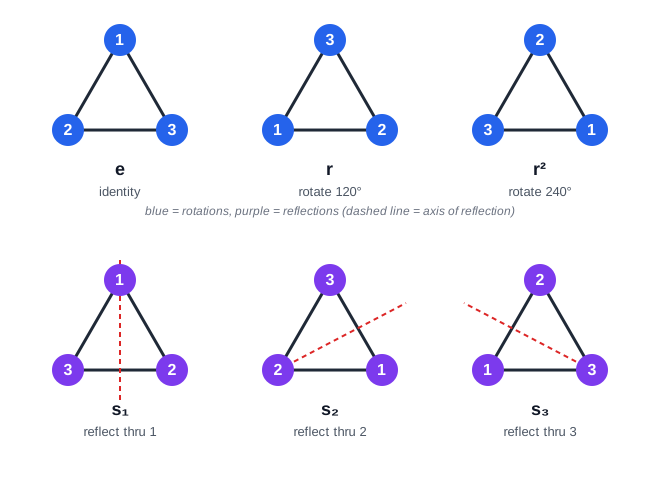
Once I had these six elements laid out, the four conditions stopped being abstract rules to memorize and turned into things I could actually check:
- Closure: composing any two symmetries — say, reflect through vertex 1, then rotate 120° — always lands on one of the same six symmetries. There’s no seventh, “new” transformation lurking outside the set.
- Associativity: composition of functions is associative in general, so this one comes for free.
- Identity:
e, “do nothing,” leaves every symmetry unchanged when composed with it. - Inverses: every symmetry can be undone by another symmetry in the set —
randr²undo each other, and each reflection is its own inverse (reflecting twice through the same axis returns the triangle to where it started).
That was the piece I’d been missing every previous time I tried this subject: the definition isn’t really about “operations” in the everyday sense at all — it’s a checklist for whether a set of things (here, symmetries) behaves consistently under a way of combining them (here, composition).
It’s a small realization, but after failing to get through this material multiple times, actually understanding it — even just this one piece — felt genuinely encouraging. Sometimes it just takes the right book, explaining things in the right way, at the right moment.